

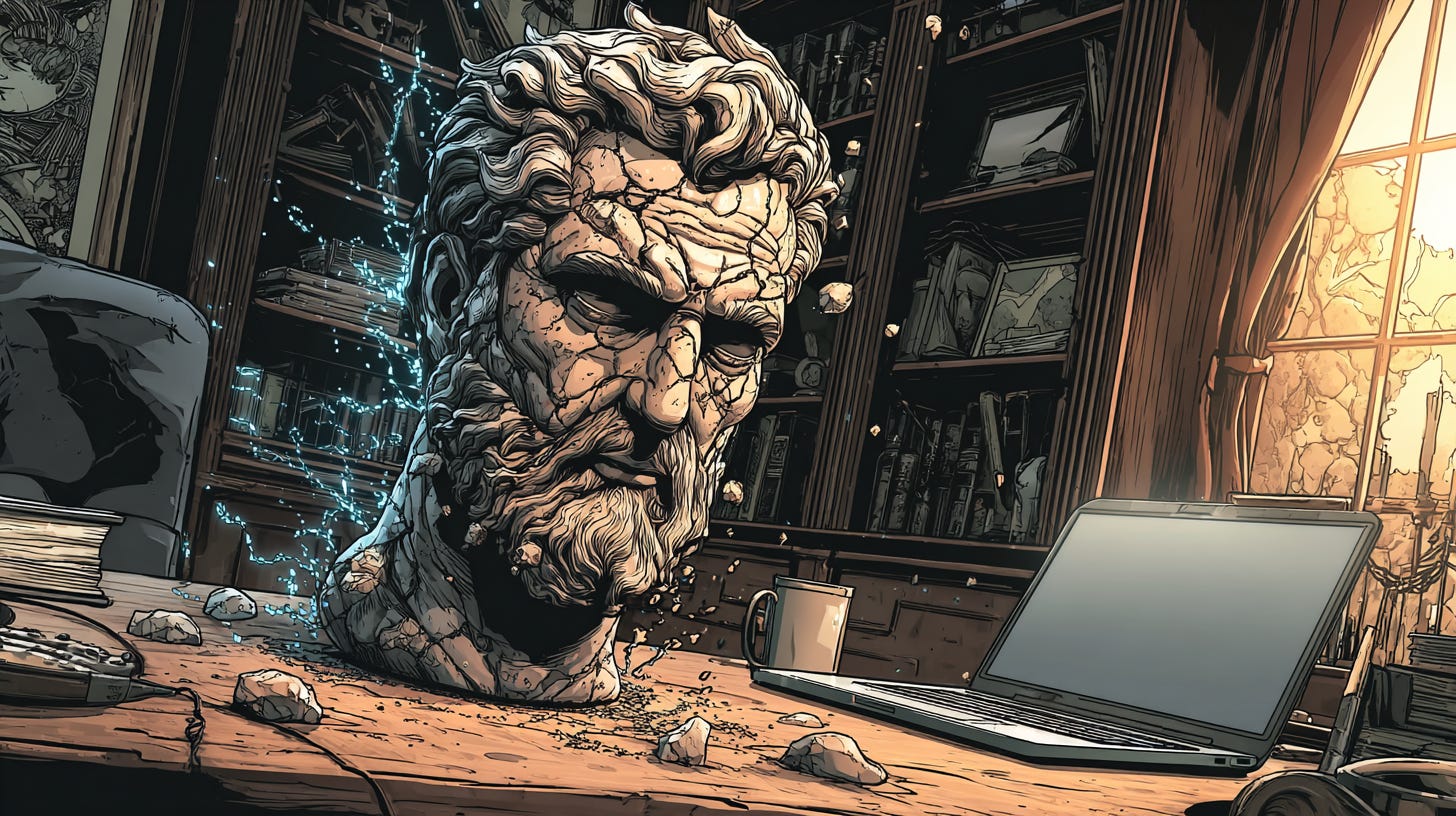
I spent three months building a Flash application back in 2003. I’m talking late nights, weekends, the whole deal. I was proud of that thing. It was slick, it was responsive, it did exactly what the client needed. I remember showing it off to my team like I’d just built the Sistine Chapel ceiling out of ActionScript.
That application doesn’t exist anymore. Neither does the company that commissioned it. Neither does Flash.
And you know what? That’s fine. Better than fine, actually. Because the Stoics figured out something about two thousand years ago that most of us in tech are still struggling to accept: everything ends, and that’s not a tragedy, it’s the whole point.
Memento Mori for Your Codebase
The ancient Stoics had this practice called memento mori, “remember that you will die.” But it wasn’t meant to be depressing. Marcus Aurelius used to meditate on his own mortality not to freak himself out, but to sharpen his focus. If your time is limited, you stop wasting it on things that don’t matter. You show up more fully for the things that do.
Now apply that to your code.
Every line you write today will be deleted, rewritten, or abandoned. Every framework you master will eventually fade into irrelevance. Every architectural decision you agonize over will be reversed by someone who thinks they know better. And honestly, they might.
This isn’t pessimism. It’s just the nature of what we do. And once you stop fighting it, something shifts. You stop writing code like you’re carving it into marble. You start writing it like it’s meant to solve this problem, for these people, right now. And weirdly enough, that makes you a better developer.
I can think back across 25 years in this industry, applications I poured myself into, systems I thought were bulletproof. Where are they now? Gone. Rethought. Reimagined. Absorbed into something else entirely. The technology moved on. The business needs changed. And the code I was so precious about? It served its purpose and then it made way for what came next.
That’s not failure. That’s the job.
Stop Building Monuments, Start Solving Problems
Here’s where most of us get tripped up. We get attached. Not just to our code, but to our tools. We wrap our entire identity around being “a React developer” or “a .NET guy” or whatever framework happens to be hot right now.
I get it. I’ve been there. When I made the jump from Flash to .NET development, it felt like starting over from scratch. All that expertise, all those years of learning ActionScript inside and out, suddenly irrelevant. It stung. It felt personal, like the industry was telling me that everything I’d invested in didn’t matter.
But here’s the thing: it wasn’t personal. React, Angular, Vue — they’ll all get replaced eventually too. Some new hotness will come along and the cycle starts again. If your identity is tied to a specific tool, you’re setting yourself up to have an existential crisis every few years.
The Stoics called this apatheia. Not apathy in the way we think of it, but freedom from being jerked around by things outside your control. You don’t control which frameworks survive. You don’t control which languages the industry decides to adopt next. What you control is your ability to think clearly, learn quickly, and solve problems regardless of the tools in front of you.
Data structures. Algorithms. System design. Communication. How to break down a complex problem into manageable pieces. That’s the stuff that transfers. That’s what you take with you from job to job, from stack to stack, from one technological era to the next.
Learning React or .NET or whatever comes next: those are just means to an end. They’re vehicles, not destinations.
The Sh*t That Actually Scares Us
The reason impermanence in tech feels so threatening isn’t because we love our frameworks that much. It’s because it triggers something deeper, the fear that we might become irrelevant.
You’ve felt it. That moment when a junior dev rewrites your “perfect” module without even reading your comments. When you’re in a meeting defending a technology choice and you can see in people’s eyes that they’ve already moved on. When you read a job posting and half the required skills didn’t exist two years ago.
That anxiety is real. And the knee-jerk reaction is to dig in. To defend the old way. To cling to what you know because at least it’s familiar. The Stoics had a word for this kind of attachment too. They called it a passion, and not in a good way. It’s an irrational emotional response that clouds your judgment and keeps you stuck.
Think about sunk cost for a second. How many times have you watched a team defend an outdated approach not because it was the best solution, but because they’d already invested so much time in it? “We can’t switch now, we’ve spent six months on this.” Yeah, and you’ll spend six more months making it work when the right answer was to let it go three months ago.
When you accept obsolescence upfront. When you walk into a project knowing that this too shall pass, you don’t fall into that trap. You make decisions based on what’s best now, not on what justifies your past choices.
The AI Elephant in the Room
And then there’s the big one. The thing that’s accelerating all of this impermanence at a pace none of us were really prepared for.
AI isn’t just another tool in the belt. It’s the impermanence engine. It’s taking skills that used to be the bread and butter of a developer’s career and commoditizing them in real time. Boilerplate code? AI handles that. Repetitive tasks? Automated. That thing you spent three years mastering? There’s a prompt for it now.
You can either freak out about that or you can see it through the Stoic lens. This is creative destruction happening at scale. The developers who thrive won’t be the ones who memorize syntax or cling to their ability to write a perfect for-loop. They’ll be the ones who know how to think. People who grasp the principles behind the code can design solutions. They can also explain complex ideas to others.
AI doesn’t replace that. It makes it more valuable.
So use the tools. Leverage AI for the grunt work. Invest your energy in timeless skills. Focus on critical thinking, problem-solving, system understanding, and the ability to learn new things.
The Beginner’s Advantage
When you know that everything becomes obsolete, continuous learning stops feeling like you’re desperately trying to keep up.
Instead, it just feels like... being alive.
Like staying curious. You’re not behind, you’re just always at the beginning of something new. And that’s actually a pretty exciting place to be.
I’ve been doing this for 25 years and I’m still learning. Not because I’m slow, but because the field demands it. What I knew a decade ago is legacy now. What I’m learning today will probably be legacy in another five to ten years. And I’ve made my peace with that.
You learn early in this career that you’ll never stop learning. You either embrace that or you burn out fighting it. There’s no third option.
Your Code Dies. Your Growth Doesn’t.
So if nothing lasts, what’s the point? Why pour yourself into something that’s just going to be replaced?
Because it was never about the code lasting forever. It was about what building it did to you. Every problem you solved made you a sharper thinker. Every failed approach taught you something about how systems work. Every late-night debugging session (as much as it sucked in the moment) added something to your toolkit that nobody can take away.
That Flash application I built in 2003? The code is long gone. But what I learned building it (how to think about user experience, how to optimize performance within constraints, how to communicate with clients who didn’t speak developer) all of that came with me. It shaped how I approach problems today, twenty years later.
The Stoics understood that external things are temporary. Your job, your title, your framework of choice: all of it can change tomorrow. But your character, your skills, your ability to adapt and grow. That’s yours. That’s what you’re really building every time you sit down at the keyboard.
Your code’s value isn’t in lasting forever. It’s in solving today’s problems and teaching you what you needed to learn to solve tomorrow’s.
Quote of the Day:
“Loss is nothing else but change, and change is nothing else but Nature’s delight.” - Marcus Aurelius
👉 If you enjoy reading this post, feel free to share it with friends!
Or feel free to click the ❤️ button on this post so more people can discover it on Substack 🙏
You can find me on X and Instagram.
Also, I just launched a new YouTube channel - Code & Composure